A farm disease response, not a blanket finding about retail eggs
South Korea's Ministry of Agriculture, Food and Rural Affairs (MAFRA) announced on 4 November 2026 that highly pathogenic avian influenza, subtype H5N9, had been confirmed at a layer-hen farm in Yeoncheon, Gyeonggi Province. The farmer had reported an increase in chicken deaths, prompting detailed testing. The ministry described it as the first confirmed case on a domestic poultry farm in the 2026–27 season. Its immediate measures focus on containing infection among farms, facilities, workers and vehicles. The announcement does not say that every egg on sale is unsafe, and it does not replace a product-specific recall or food-safety notice.
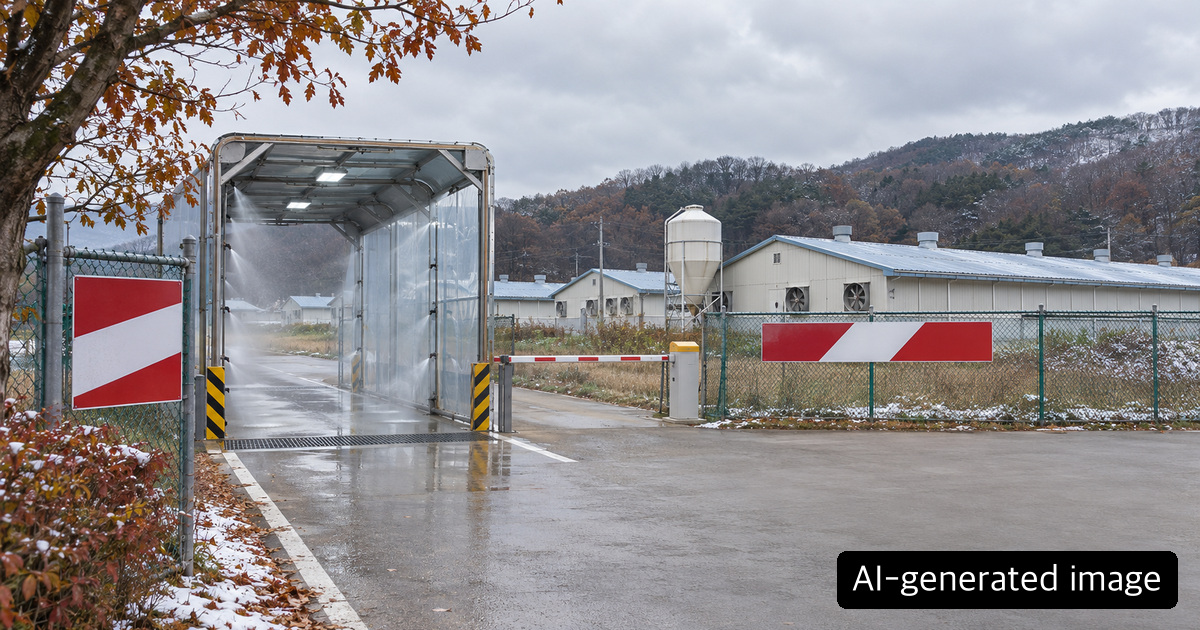
The cover is an AI-generated conceptual farm entrance, not a photograph of the farm involved or evidence of what happened there.
The national 24-hour stop order has a specific time window
The original release says a temporary national movement-stop order covered poultry-related farms, facilities and vehicles from 11:00 a.m. on 4 November until 11:00 a.m. on 5 November 2026. By the evening of 5 November, that stated end time had passed. Readers should not infer from the original announcement alone that a nationwide stop order remains in force. Equally, expiry of that national period does not by itself lift a local control-zone instruction or a later extension. Before moving animals, equipment or vehicles, an operator must check the latest MAFRA order and directions from the relevant local authority.
The affected farm itself was subject to an initial response team, access control, culling and an epidemiological investigation, according to the ministry. Those actions at the confirmed farm are not a statement that every nearby or national farm is being culled. People who work in the supply chain should distinguish the original nationwide stop, local restrictions, and site-specific veterinary orders instead of treating them as one blanket rule.
What happens around the confirmed farm?
MAFRA identified 17 poultry farms within approximately 10 km of the affected farm for detailed testing. It also said a dedicated official would be assigned to each to oversee movement control, disinfection and testing. The figure 17 is a count of farms in the response zone at the time of the release; it is not a count of 17 confirmed infections. Staff at those farms and drivers planning visits should confirm the applicable route, registration and cleaning requirements with the assigned official or local government before entry.
Outside that zone, the ministry said it would intensify disinfection near migratory-bird sites, streams, reservoirs and farm approach roads. It also called for tighter controls at large layer farms and concentrated farming areas. These are practical biosecurity measures directed at reducing the chances that people, equipment or vehicles carry infection between locations. The precise instruction for an individual holding still depends on its location and the current order.
Disinfection continues longer than the original stop period
The government designated 4–17 November as a nationwide intensive disinfection period for poultry farms, livestock facilities and related vehicles. This two-week campaign is separate from the 24-hour national movement-stop window. A reader should not write that disinfection ended on 5 November merely because that was the scheduled end of the stop order. Farm operators should maintain entrance controls, visitor and vehicle records, and cleaning practices under the official instructions applicable to their premises.
The release also outlined weekly special inspections by local governments at layer farms. It differentiated management of farms with at least 100,000 birds from a plan for control posts at farms with at least 200,000 birds. Egg-transport vehicles and external teams, including vaccination and loading crews, were singled out for advance registration and stricter access control. The two bird-count thresholds should not be collapsed into a claim that every layer farm must install a staffed post.
A short operational checklist
If you run a poultry farm or schedule vehicles for one, first check whether the property is in the Yeoncheon response zone or covered by a later movement order. Confirm the current position with the local authority or assigned officer, not only with a dated news article. Then reconcile planned visitors, egg-collection vehicles and outside crews against registration and entry rules. Keep the disinfection and access records that the applicable instructions require, and review whether farm approaches and work areas are actually being cleaned. An unusual rise in bird deaths should be reported promptly through the official animal-health channel rather than treated as an ordinary production issue.
For consumers, the farm announcement is not a substitute for a food-product notice. A specific recall, sales suspension or safety advisory should be checked on its own terms. Do not extrapolate either that all retail eggs are contaminated or that the farm response guarantees the safety of every product. This article describes the ministry's 4 November announcement and the identified notice; later extensions, local restrictions and inspections may change the operational position.
About the Author
The Life Mokcha editorial team reviews official announcements and primary sources to explain practical information. Check the linked original sources for applicable terms and later updates.