
Does a private school’s 9% Teachers' Pension contribution become the employee’s severance savings? No. A pension contribution finances a public pension scheme; severance pay and the pension scheme's separate retirement allowance follow different rules. In this guide, “ordinary pension” means South Korea’s National Pension (국민연금). Checked 28 September 2026.
First identify the worker’s actual pension scheme
| Employment status | Main statutory pension | Separate retirement payment to check |
|---|---|---|
| Private-school employee covered by Teachers' Pension (사학연금) | Teachers' Pension | Pension or lump-sum benefit, plus a distinct retirement allowance (퇴직수당) |
| Public-school teacher with civil-servant status | Government Employees Pension (공무원연금) | That scheme's retirement entitlements |
| Ordinary employee not covered by an occupational public scheme | National Pension if eligible | Employer's statutory severance pay or workplace retirement pension (DB/DC) |
Not everyone working at a school belongs to Teachers' Pension. Check the employment contract and actual enrolment; a school worker's job title alone is insufficient. A person’s earlier National Pension periods may also need a separate portability or entitlement check.
What is deducted in 2026?
- Teachers' Pension: An insured employee contributes 9% of the applicable standard monthly income. Other contributors supply another 9%. For private-school teachers, the school corporation and government divide that second portion; for covered administrative staff, the school-operating body pays it. The standard pension contributions total 18%, but that is not an 18% salary deduction or a personal severance account balance.
- National Pension: The 2026 rate is 9.5% of standard monthly income. For an employee enrolled through a workplace, 4.75% comes from the employee and 4.75% from the employer. Other enrolment categories, such as individual subscribers, normally bear the full applicable rate themselves. Do not substitute the pre-2026 9% rate or the future 13% target for the 2026 figure.
Standard monthly income is calculated under each scheme’s rules. Similar-looking rates do not by themselves determine or compare future pension payments.
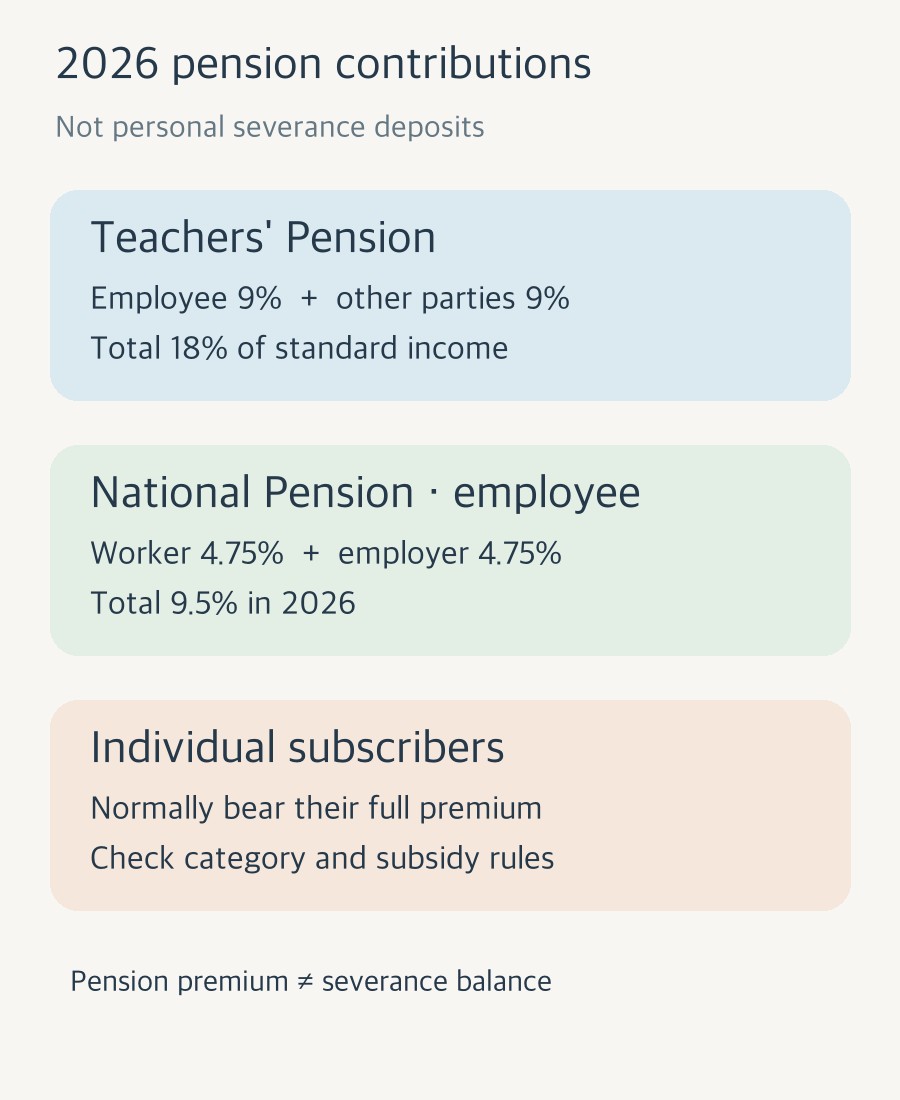
Why the other 9% is not severance savings
Pension contributions fund scheme benefits. The employee cannot simply withdraw the sum of their own and the other contributors’ monthly payments as though it were a personally earmarked deposit. Pension or lump-sum entitlements instead depend on statutory qualifying conditions, service or contribution history, and income records.
For an ordinary employee, statutory workplace retirement benefits are separate from National Pension. Under a severance-pay arrangement, the employer must provide at least 30 days of average wages per year of continuous service to an eligible departing employee. A workplace retirement pension may instead use defined-benefit (DB) or defined-contribution (DC) rules. Do not claim all employers deposit a fixed share into each worker’s personal account: the arrangement matters. Basic eligibility includes at least one year of continuous service and a scheduled workweek averaging at least 15 hours over four weeks.
Teachers' Pension retirement allowance: what does 6.5–39% measure?
The Teachers' Pension Service describes a separate retirement allowance (퇴직수당) for covered employees leaving after at least one year of eligible service or upon death. For service from 2010 onward, its formula uses standard monthly income × recognized years for the allowance × service-band payment rate.
| Recognized service for the allowance | Payment rate |
|---|---|
| 1 year to under 5 years | 6.5% |
| 5 years to under 10 years | 22.75% |
| 10 years to under 15 years | 29.25% |
| 15 years to under 20 years | 32.5% |
| 20 years or more | 39% |
These are payment-formula multipliers, not percentages deposited every month and not an annual percentage of salary paid out every year. Pre-2010 service follows the former monthly-pay basis and payment-rate schedule and is combined separately. The service period counted for the allowance has exclusions and a 33-year cap. For a real estimate, consult the pension service.
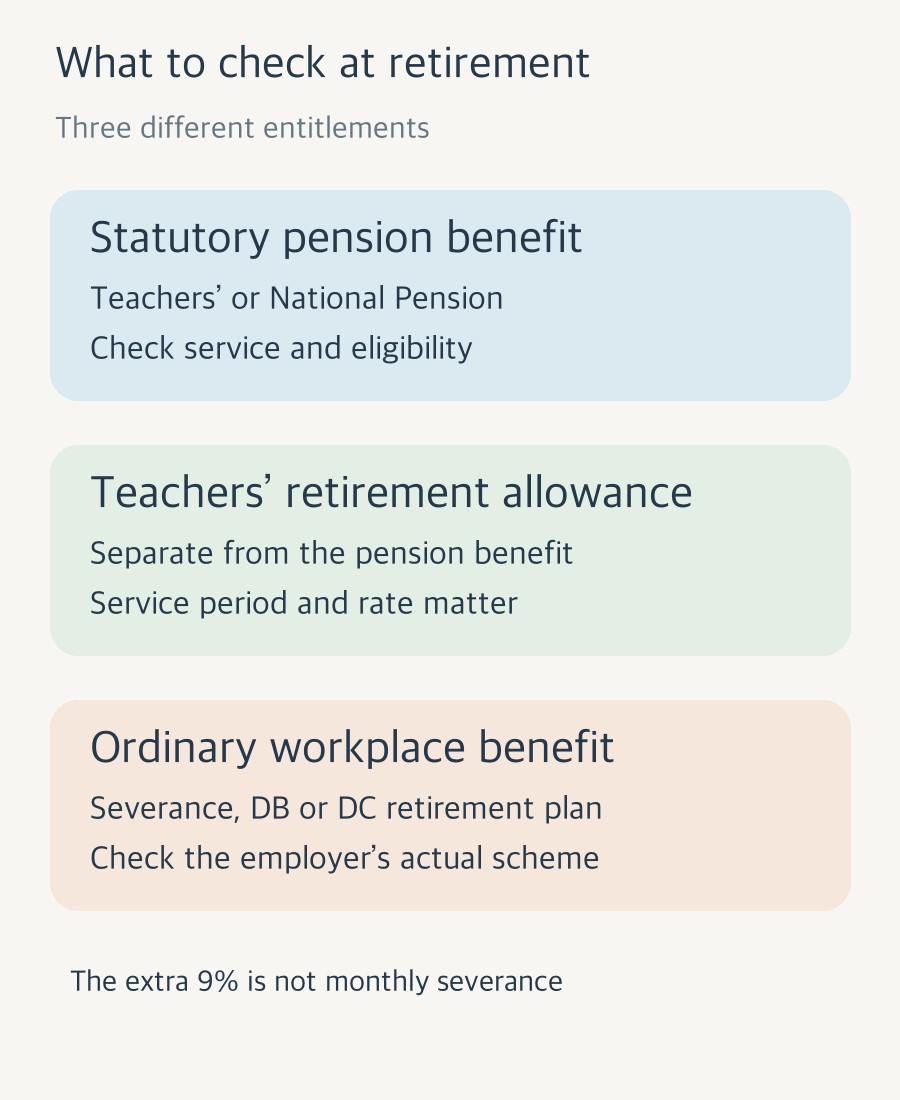
A practical payslip checklist
- Verify which pension scheme your payslip and pension record actually name. Do not infer it solely from the school’s name.
- Distinguish your payroll deduction from the school, government, or employer contribution. The total is not your personal savings balance.
- If you are covered by Teachers' Pension, check recognized service and an allowance estimate with its service office. If you are an ordinary employee, ask your employer whether it provides severance pay, DB or DC retirement benefits and review your actual records.
- If you changed employment categories, ask the relevant institutions about earlier National Pension contributions, linkage and qualifying conditions. Neither table here is an individual net-of-tax quotation.
For a shorter Korean question-and-answer version, see Life Mokcha on Naver.
About the Author
Life Mokcha distinguishes contribution rates, allowance formula rates, and statutory workplace retirement benefits. This is general information, not personalized pension or tax advice.
References
- Ministry of Health and Welfare: National Pension membership and premiums
- Teachers' Pension Service: retirement allowance and qualifying service
- Private School Teachers and Staff Pension Act
- National Pension Service: workplace membership
- Ministry of Employment and Labor: severance and average-wage calculation