Korea is not cancelling every solar generator's renewable energy certificate (REC) on January 1, 2027. In a September 15, 2026 announcement, the Ministry of Climate, Energy and Environment (MCEE) said that amendments to the renewable-energy law were promulgated and are due to take effect on January 1, 2027. The policy moves away from the Renewable Portfolio Standard (RPS) toward a competitive, long-term contract market. The crucial distinction is between a new project seeking entry and an existing project covered by transition rules.
As of September 26, 2026. The table below reorganizes the ministry's announcement by project situation; it is an editorial comparison, not an official eligibility decision. Implementing decrees and rules were still under consultation, and the first solar tender notice was planned for 2027. No auction ceiling, capacity, small-project threshold, revenue or award is established for an individual project by this article. Do not assume that a household solar system used for self-consumption must enter this generator-focused auction.
The amended law's transitional provisions also address REC holders by the end of 2026 and operators who obtained an electricity-generation permit before commencement and meet recognition requirements under a later ministerial notice. Installation date alone does not settle eligibility for the former REC route.
For a shorter Korean-language overview, see the Life Mokcha Naver edition.
Which path describes your project?
On a phone, swipe sideways within the table to read the final column.
| Situation | 2026 | 2027 path |
|---|---|---|
| New project | RPS, REC, fixed-price contracts | Auctions; award required for KEPCO deal. Check permit exceptions. |
| Existing REC | Issuance by recognition and contract | Transitional issuance up to 20 years; no automatic extension. |
| REC spot | Existing REC trading | Grace period through Dec. 31, 2029. |
| Small project | Current support and contract routes | Separate market planned; details pending. |
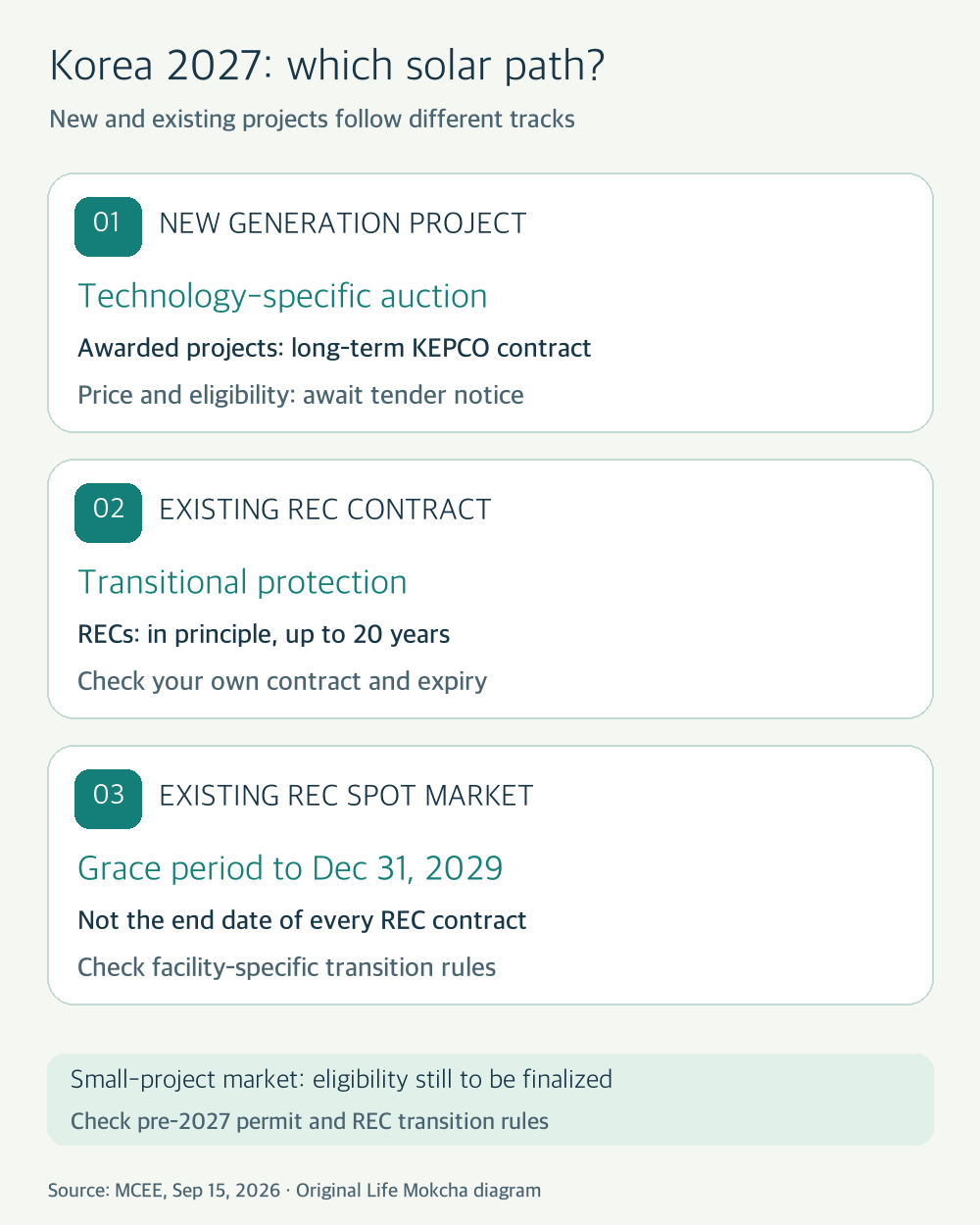
December 31, 2029 refers to the planned end of the REC spot-market grace period, not a universal end to existing contracts or certificates. Conversely, the protection for existing operators does not mean any newly proposed project can always enter the old RPS system. Check the final transitional criteria before making a project-specific decision.
What changes—and what remains open?
Under RPS, obligated suppliers could meet renewable-energy obligations through their own generation or REC purchases, among other routes. The announced reform shifts new generation-project entry toward government-run, competitive long-term contracts. MCEE says bids may be assessed on non-price factors such as domestic industry, supply-chain and energy-security contributions alongside price. A more predictable contract structure for winners is not a guarantee that every bidder wins or earns a fixed return. Compare the eventual ceiling, winning bid, duration and obligations only after the first tender notice is published.
The September 23, 2026 draft implementing rule proposes 500 kW or less as the small-facility threshold. It is a consultation proposal, not a final 2027 auction-eligibility rule. Check the adopted regulation and first tender notice for the final size, qualifications and terms.
MCEE scheduled a September 30 public hearing, planned to complete implementing rules within 2026 after consultation, and aimed to announce the first solar and wind tenders in 2027. A hearing scheduled is not a hearing already held, and a planned tender is not a published set of prices and returns. Forecasts using a supposed settled 2027 auction price would be premature as of this article's date.
Four checks before planning or renegotiating
- Classify the use and status: Is it a self-consumption household system or a commercial electricity-generation project? Is the plant operating, only permitted, or not yet developed? The announcement alone cannot determine whether a specific permitted project falls under transitional rules.
- Read existing agreements: For an REC contract or spot trader, verify counterparties, contract expiry, facility recognition and trading conditions. “Up to 20 years” is not a new identical term granted to everyone.
- Wait for the new-project notice: For a proposed 2027 solar project, compare the final tender's eligible capacity, price ceiling, award criteria, contract obligations and small-project route. The September draft implementing rule is not a binding tender.
- Check home-solar rules separately: This article addresses the generator contract-market reform. Household self-consumption, installation grants, grid connection and electricity sales can have different eligibility rules; use the relevant agency program guidance and your contract.
The cover and comparison graphic are original Life Mokcha typography-and-shape diagrams. They are not a government tender notice, tariff sheet, REC trading screen or revenue guarantee. No government photo, poster or chart was reused.
About the Author
The Life Mokcha editor separates the announced treatment of new and existing renewable-power projects, distinguishing the future effective date of the promulgated law from unfinalized auction conditions.
References
- MCEE, September 15, 2026 press-release page on renewable-energy market reform — primary source for auctions, existing REC treatment, spot-market grace period, hearing and planned rules.
- Korean Law Information Center, amended Renewable Energy Act, Article 12-14 and transitional provisions — enacted contract-market basis, commencement and statutory REC/grandfathered-permit exceptions.
- MCEE press-release PDF hosted by Korea Policy Briefing — full original with attachments; the same ministry source chain, not independent corroboration.
- Korean public legislative consultation center, September 23, 2026 draft implementing rule — direct source for the proposed 500 kW threshold, not a final rule.