
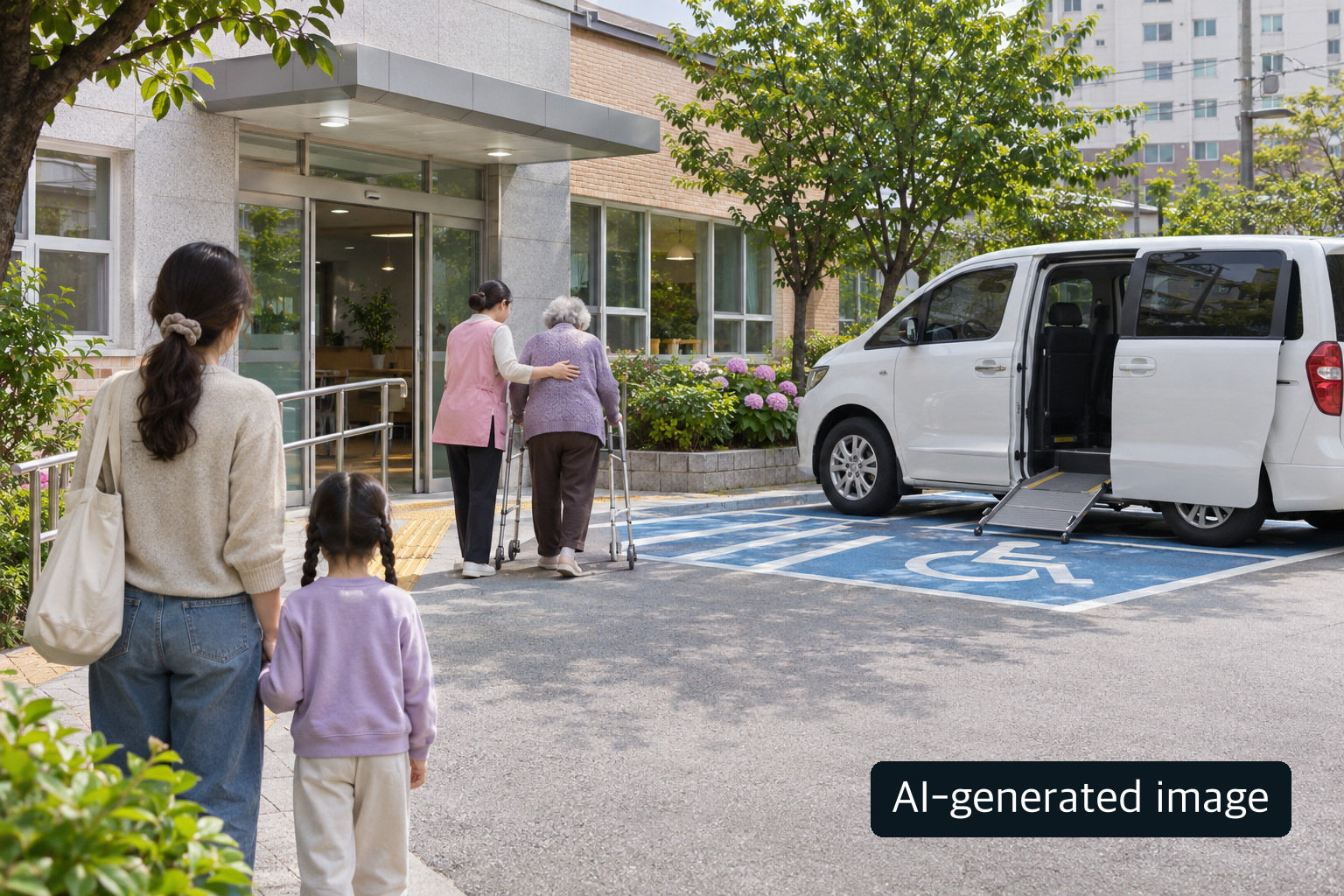
Korea's Ministry of Health and Welfare announced on November 3, 2026 that the Cabinet had approved an amendment to the Enforcement Decree of the Act on the Guarantee of Convenience of Persons with Disabilities, the Aged, Pregnant Women, etc. It would add certain foster carers of children with walking disabilities and certain day-and-night care providers' vehicles to the scope of the disability parking placard system. Approval of a decree proposal does not itself issue a placard or authorize immediate parking. The proposed supplementary provision says it takes effect on promulgation; the promulgation date must be checked in the current official law record before treating it as effective. The cover is an AI-generated illustration, not an actual Korean placard or facility.
Foster care: the child's condition and legal placement both matter
The new carer category concerns a person protecting a child under the foster-care placement measure in Article 15(1)(3) of the Child Welfare Act, where the child belongs to the existing category of people with a walking disability. The proposal adds one automobile registered in that carer's name and used by the carer to the relevant class. The new sub-item sits under Article 7-3(1)(1)(c), whose shared condition requires the carer and qualifying person to have the same registered residential address and live together. It does not cover every foster household, every child with a disability, or every vehicle borrowed to transport a child. A reader should verify the child's qualifying walking-disability status, formal foster-care relationship, shared address and actual cohabitation, vehicle registration and the issuing authority's current requirements. The government announcement alone does not establish that any particular family has already received a usable placard.
The proposal also addresses what happens when foster care ends. If a person continues using the placard to park in a designated space after the foster-care protection for the qualifying person has ended, the amendment provides for recovery of the placard. A prior issue of a placard is therefore not a permanent permission divorced from the care relationship. Ask the issuing authority about validity, return and any changed circumstances rather than assuming that a former carer may continue using it.
Day-and-night care: institution registration and business use matter
One newly described vehicle category is an automobile registered in the name of a home-based elderly welfare facility that provides day-and-night care under the Elderly Welfare Act, and used for its elderly welfare business. The other is an automobile registered in the name of a long-term care institution providing day-and-night care under the Long-Term Care Insurance Act, and used for that long-term care business. The decree proposal also includes the legacy home-care institutions that are deemed long-term care institutions under the cited transitional provision. Simply carrying an older passenger or operating a van is not the test. The facility's legal category, service, registered vehicle owner and business use must be checked together. The common proviso in Article 7-3(1)(3) permits a vehicle registered in the representative's name when the qualifying facility or organisation has no separate legal personality; it is therefore inaccurate to insist on institution-name registration in every case.
An ordinary employee's personally registered car, a provider that offers a different service, or a vehicle outside the stated business-use conditions should not be presented as automatically eligible. The press release does not give a universal document list or processing time for every applicant. Facility managers should confirm the promulgated text and seek the current application instructions from the competent placard issuer before preparing records or changing parking operations.
When can an applicant use a designated space?
The November 3 event was a Cabinet decision on a decree amendment. The draft's supplementary article reads, in substance, “effective on the date of promulgation.” A Cabinet decision, legal commencement and individual placard issue are separate steps. Because a verified promulgation date has not been established in this article, it would be misleading to say that every newly listed vehicle could use an accessible parking space from November 3. Check the latest official law text and the issuer's guidance; even after commencement, confirm the actual issued placard and its conditions before parking.
The same amendment also changes a separate rule on baby-changing fixtures in certain toilets, including homes for older people and senior centres. That change does not abolish disability-accessibility obligations generally and does not enlarge parking-placard eligibility. A facility planning construction should assess that provision against its own type of premises rather than taking a parking article as a building-compliance instruction.
A practical pre-application check
For a foster household, establish the qualifying walking disability, statutory placement, shared registered address, actual cohabitation and one registered vehicle before asking the issuer whether the amended category is in force. For an institution, match its day-and-night care licence and business use to the exact decree language and registration record. In both cases, check the promulgation date, current forms and filing route directly with the responsible public authority. An unsolicited message promising an instant placard in exchange for a fee, account details or identity documents should be verified independently through an official channel. Neither this article nor an image of a vehicle substitutes for a government-issued permit.
About the Author
The Life Mokcha editorial team reviews official announcements and primary sources to explain practical information. Check the linked original sources for applicable terms and later updates.