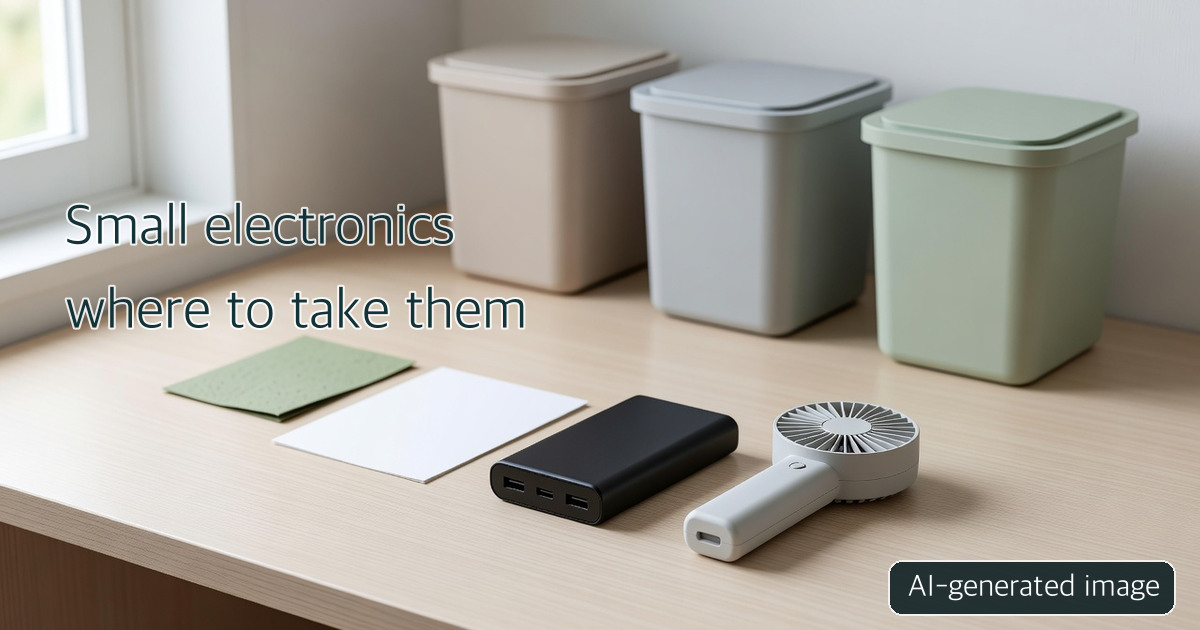
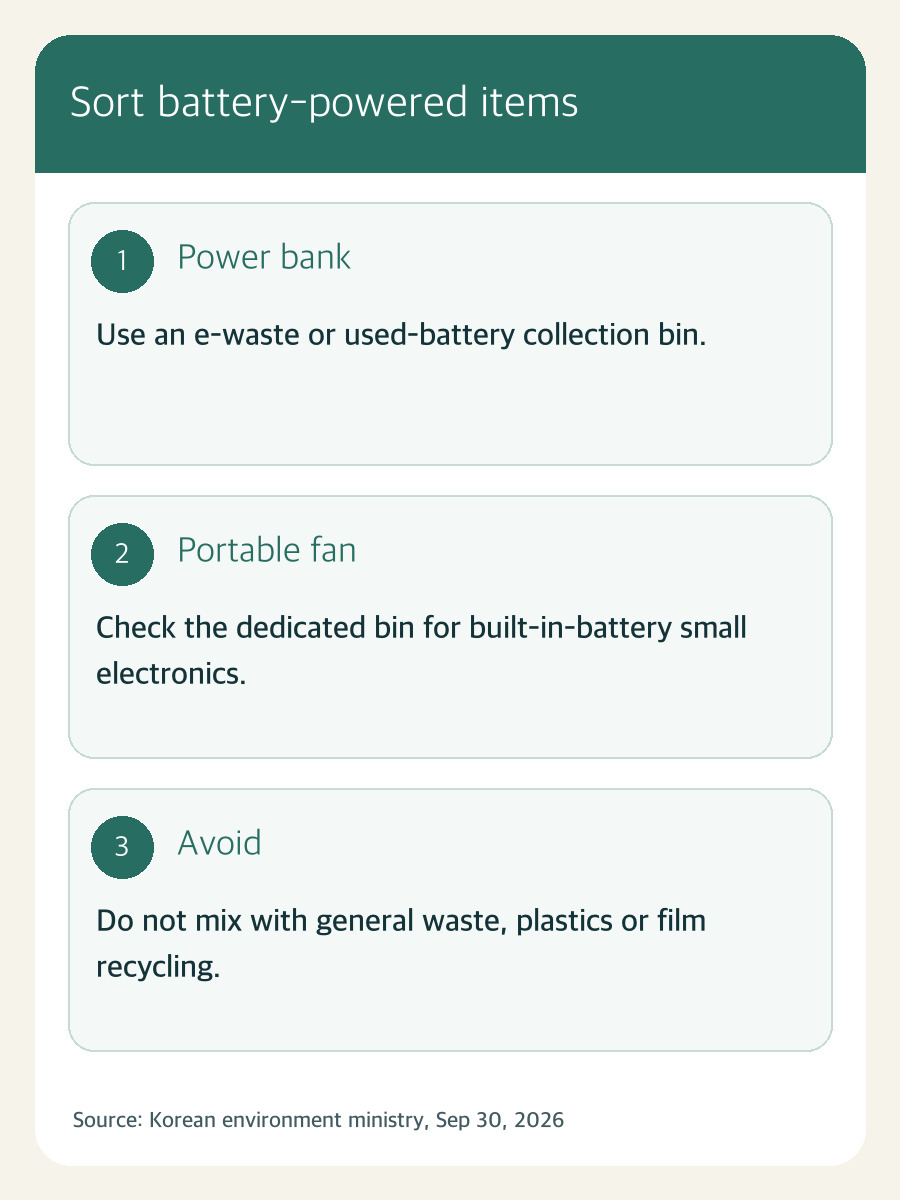
A power bank's plastic shell does not make it ordinary plastic recycling. On September 30, 2026, Korea's Ministry of Climate, Energy and Environment (기후에너지환경부) reminded households that a power bank or a handheld fan with a built-in battery can be damaged during waste sorting and compaction, potentially causing a fire. Do not mix these devices into standard garbage bags or plastic and film recycling; the attached official poster also excludes the ordinary scrap-metal stream. Instead, look for a dedicated small-electronics/e-waste or used-battery collection bin, subject to the particular site's accepted items.
First ask whether the battery detaches normally
| What you have | Practical sorting step | Do not assume |
|---|---|---|
| Power bank | Keep the unit intact and check the site labels for an e-waste or used-battery bin | A plastic shell belongs in plastics, or every place accepts power banks in one particular bin |
| Handheld fan with a built-in battery | Do not pry the case apart; check a dedicated bin that accepts the whole small appliance | A small battery-bin opening is always suitable for the entire fan |
| An appliance with an easily removable battery | Check the e-waste stream for the body and the used-battery stream for the separated battery | “Removable” includes breaking open sealed equipment with tools |
The ministry's general statement names e-waste or used-battery bins for battery-equipped items. Its detailed poster illustrates inseparable power banks and mini-fans under a small electronics flow. Read the actual collection point's signage and ask its operator if the item's size or category is unclear. Do not force a fan into an opening intended only for loose batteries.
A map listing is a starting point, not permission to deposit
- Korea's Waste Sorting Guide location map (분리의 정석) offers categories for e-waste bins and battery bins. Search both where relevant.
- Confirm the actual address, access rules and posted accepted-items list. The map warns that a collection point inside an apartment complex may be inaccessible to people who do not live there.
- If a listed bin does not accept your item, or none appears nearby, ask the building operator or your local authority about an appropriate handover. Do not substitute a regular trash or plastics bin.
The September 30 announcement also describes a planned link to internet maps, including Naver, for dedicated collection-bin locations. At the time of the announcement, it said only locations of bins installed by the producer-responsibility consortium were displayed; adding local-government-installed bin locations was planned through October 2026. It did not say the October integration had already finished, nor that every bin in the country was on every map. The Waste Sorting Guide is another search starting point; do not equate its category listings with the exact dataset referred to in the ministry's map-integration statement.
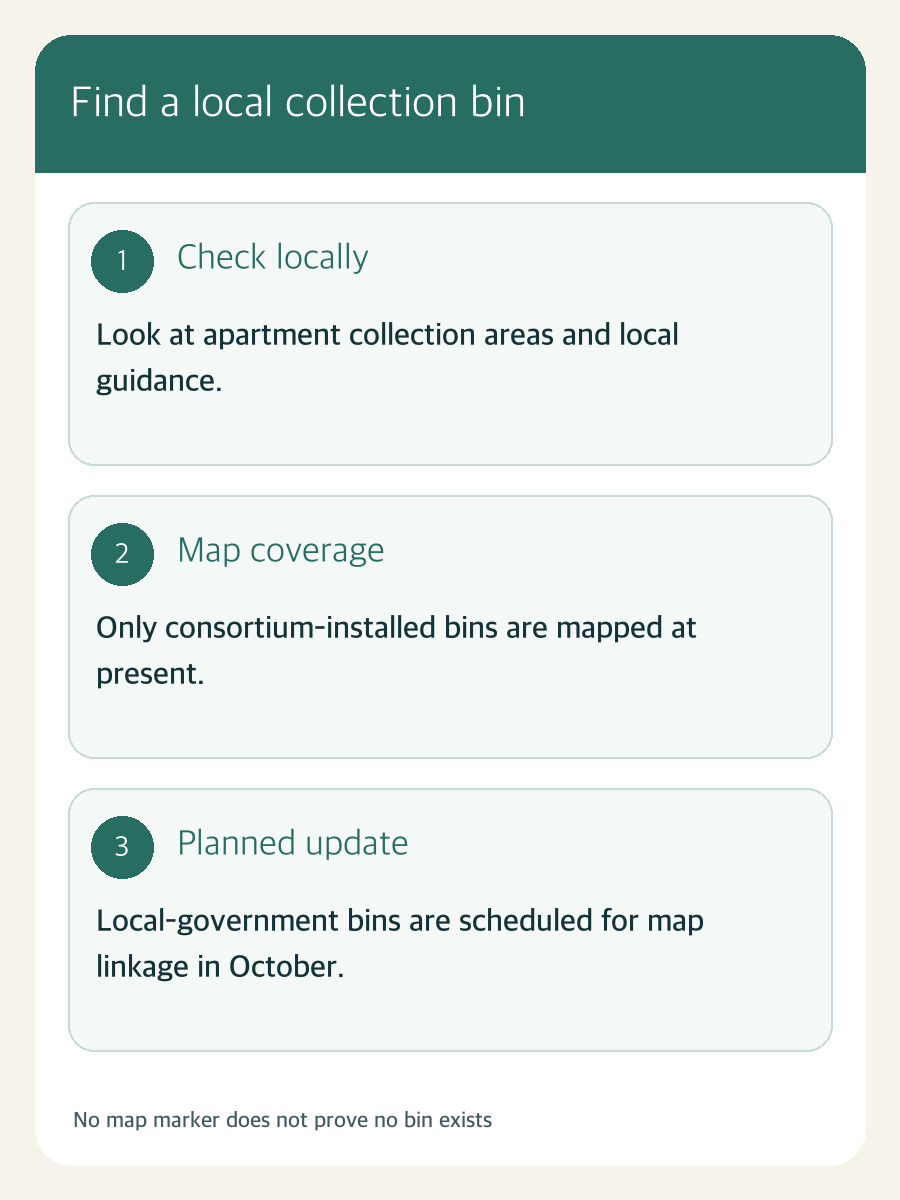
Swollen, leaking, damaged or hot battery products require extra care. The ordinary-device guidance above does not establish a safe transport or bin-drop procedure for them. Tell the collection operator or local authority about the condition and ask how to hand over the product safely. The cover is an AI-generated conceptual image, not a photograph of a real disposal facility or government poster. The two explanatory cards are original designs based on verified text, not reproductions of the attached official poster.
A shorter Korean checklist is available in the Life Mokcha Naver article.
About the Author
The Life Mokcha editorial team (목차지기) distinguishes national sorting advice from the access and accepted-item rules at a particular collection point.
References
- Ministry of Climate, Energy and Environment, power-bank and small-electronics disposal announcement (September 30, 2026; Korean)
- Official press-release PDF and attached illustrated sorting guide (bin types, removable batteries, planned map integration; Korean)
- Waste Sorting Guide (분리의 정석), collection-point map (check access and accepted items locally; Korean)