
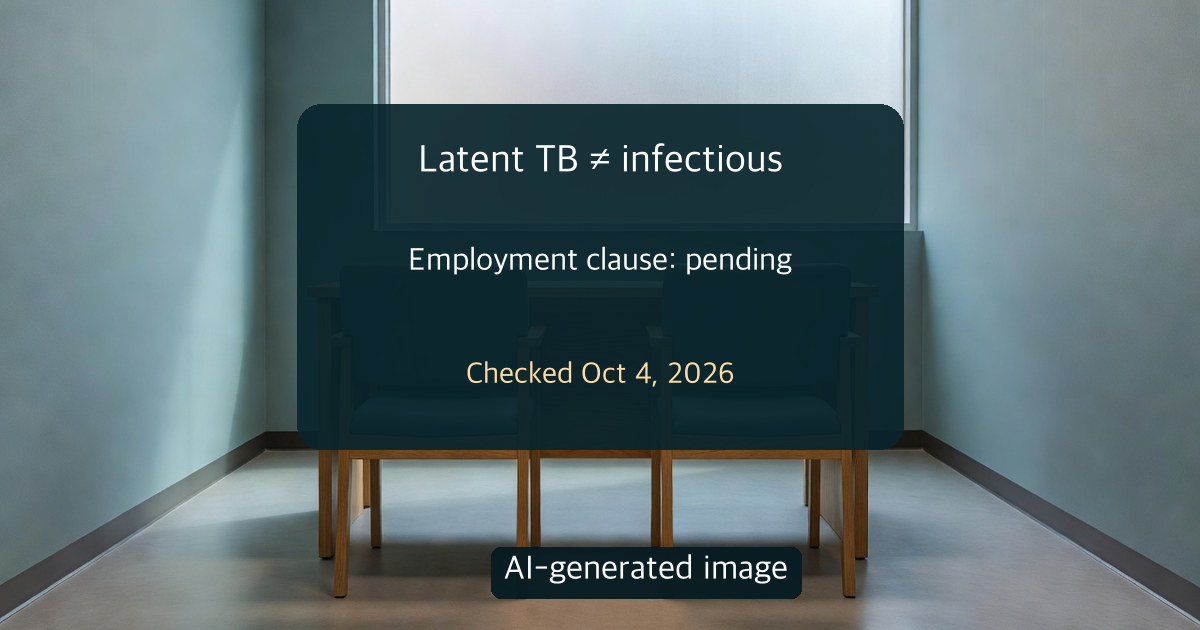
Checked October 4, 2026: South Korea's Disease Control and Prevention Agency (KDCA) says latent tuberculosis (TB) infection itself causes no symptoms and does not transmit TB bacteria to other people. An amendment expanding the employment-refusal prohibition passed the National Assembly on October 1. Passage is not commencement. The currently displayed Article 13 still does not expressly list latent infection in that clause, and the reviewed KDCA announcement does not specify when the expanded clause takes effect. Check the promulgated statute and transitional provisions before relying on it.
Start with the medical distinction
- Latent TB infection: TB bacteria are present but active disease has not developed. KDCA describes this condition as symptom-free and noninfectious; it does not spread TB to others. Do not automatically apply today's temporary work restriction for infectious TB disease to someone with a latent infection result.
- Possible active TB disease: KDCA lists symptoms such as a persistent cough or fever, while noting that early active disease can sometimes be symptom-free. Infectious TB may spread through the air when the person coughs or talks. This does not mean every active TB case is infectious or that a symptom check alone settles the diagnosis. Have a clinician interpret the screening result and assess whether active disease must be ruled out.

Which employment rule applies today?
The current Article 13(4), as displayed by the National Law Information Center on October 4, says an employer cannot refuse employment to a noninfectious TB patient solely because that person is a TB patient. The KDCA's October 1 old/new comparison would add people with latent TB infection to the prohibition on refusal solely on that ground. Do not cite the proposed additional wording as already effective. Conversely, this article does not assess or exclude every other employment right or possible remedy under other laws.
If an employment concern arises, confirm what your clinical result means, request the specific reason and rule being applied, and check the finally promulgated law and commencement status with an appropriate authority or adviser. Article 13's temporary work restriction for infectious TB patients is a separate existing provision; a latent result should not be treated as that finding.
Screening, treatment and the limited 2027 plan
The KDCA attachment distinguishes screening for identified contacts of infectious patients, staff at certain institutions subject to screening duties, and medically high-risk people whom a clinician may advise to test. It describes treatment for latent infection as based on informed, voluntary consent; treatment may be recommended for high-risk groups and certain institutional workers. Discuss individual testing or preventive treatment with a clinician or local public health center.

Screening support in 2027 remains a plan. KDCA announced support for some workers in residential child-welfare facilities and shelters for children affected by abuse, among other covered settings. Local governments are to announce detailed eligibility and application methods alongside implementation. This is not a currently open application for all workers, nor does the reviewed release establish a January 1 start date.
Decision: distinguish a clinical result from infectious disease, and distinguish today's statutory wording from a bill that has passed parliament. A shorter Korean Q&A is on the Life Mokcha Naver post.
About the Author
The Life Mokcha editorial team compared KDCA's original October 1 PDF with the version of Article 13 displayed on October 4, 2026. This general guide is not a diagnosis or legal advice about an individual employment dispute.