
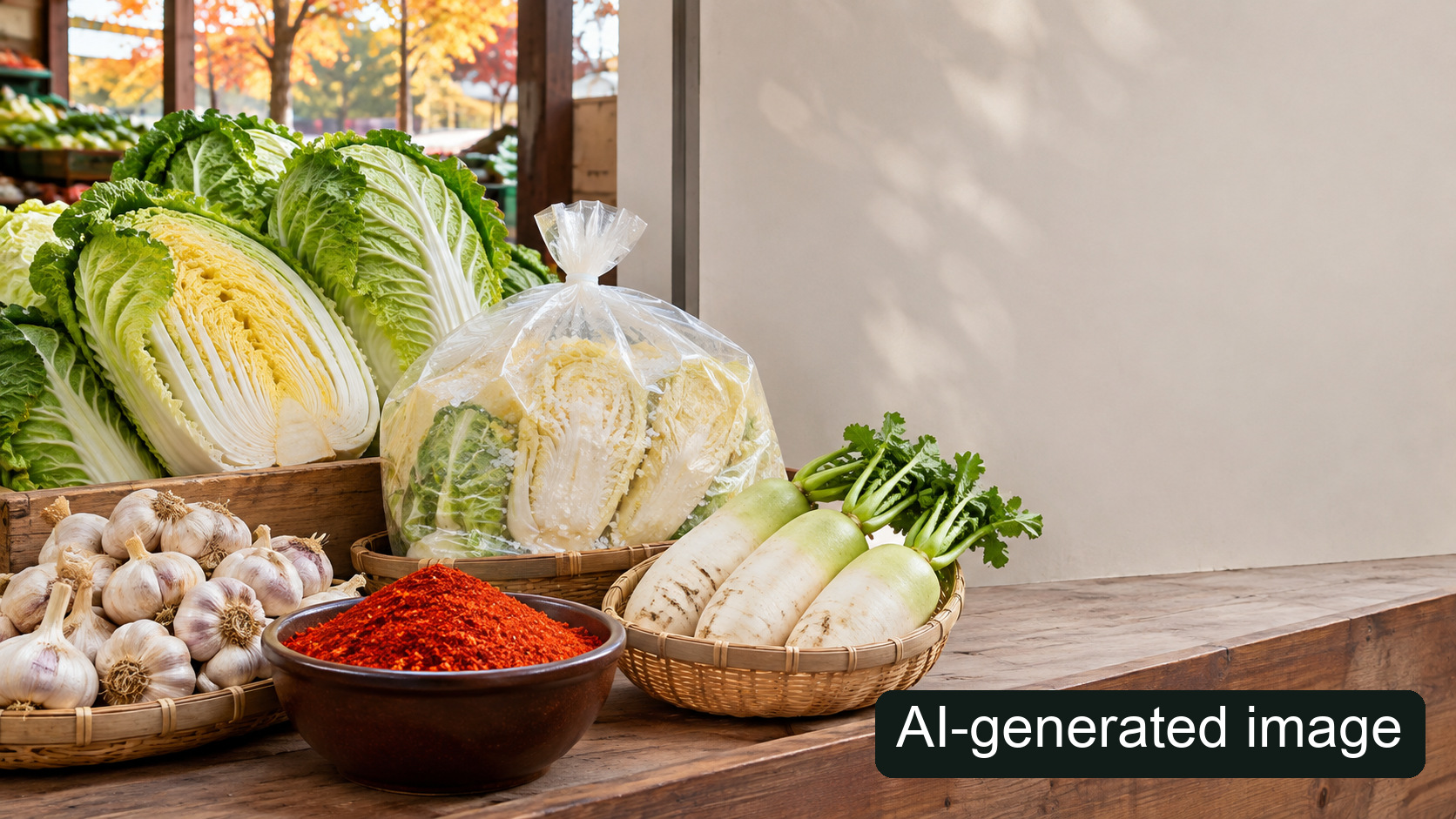
The National Agricultural Products Quality Management Service (NAQS) announced on November 2, 2026 that it will intensively inspect origin labeling for kimchi-making ingredients from November 4 through December 4, a 31-day period. The announcement identifies napa-cabbage kimchi, salted cabbage, chili powder, garlic and ginger among the main products. It does not identify a particular item in your shopping cart as mislabeled. This cover is an AI-generated concept scene, not evidence of a real product, its origin, or an inspection. The Korean Naver article offers a shorter shopping-screen checklist.
Identify the product you are actually buying
Whole cabbage, pre-salted cabbage and ready-made cabbage kimchi are different purchases. A product photo or the phrase “for kimchi making” does not tell you which ingredient an origin label refers to. Read the selected product name, the contents of a bundle and the label associated with each item. If you are also ordering chili powder, garlic or ginger, inspect the listing and delivered package for each of those products. A label describing cabbage should not be assumed to describe every seasoning in the same cart.
The inspection dates describe the agency's campaign; they are not the dates on which consumers first need to check labels. Before ordering, locate the origin information on the current listing and check whether an option changes the product or its composition. After delivery, compare the package with the item and description you ordered. If a label is hard to find, ask the seller where the specific product's origin is stated. Difficulty finding a label is a reason to seek clarification, not by itself proof that the seller falsely labeled the product.
Online sellers are within the planned checks
According to the release, NAQS plans to focus on kimchi manufacturers and sellers, mail-order businesses and ordinary restaurants. Its cyber-inspection team will monitor online marketplaces, shopping malls and home-shopping channels, followed by on-site checks where a violation is suspected. This does not mean every online listing has already been inspected or certified. It means online selling is one of the channels included in the campaign.
Keep the product page, order details and package information together if what you receive seems different from what was advertised. These records can make a question to the seller or an agency report easier to explain. They are a practical suggestion, not a mandatory list of reporting documents established by this press release. Describe exactly which item and wording concern you; avoid treating a bundle's general marketing copy as an origin statement for every component without checking the item-level information.
Appearance is not a verdict on origin
An annex to the official PDF gives visual examples for several agricultural products. Such examples should not become a consumer's definitive test for an individual item. Shape and color can change with variety, handling, processing, storage and photography. Neither an online photograph nor this article's AI-generated cover establishes where particular cabbage, chili or garlic was grown. Start with the actual origin label. If the label is missing or a false statement is reasonably suspected, ask the responsible agency to investigate rather than publicly declaring the seller guilty based on appearance.
The agency says it will pay particular attention to foreign-origin goods sold as domestic and to domestic goods falsely presented as coming from a well-known Korean region. Importing or choosing foreign-origin goods is not the wrongdoing described here; misleading the buyer about origin is the concern. A surprising price is not proof of an incorrect origin statement. Compare the actual product description and package before drawing conclusions.
How to report a suspected labeling problem
NAQS asks consumers who find no origin indication or suspect a false one to contact its improper-distribution reporting center at 1588-8112. Explain the product, seller or sales channel, the label you saw and why it appears inconsistent. If possible, distinguish the seller's response from the package and listing text. A report requests an official check; the caller does not make the legal finding.
The release distinguishes the consequences of two types of violation. False origin labeling, when established, can lead to publication of the business name and violation for one year and is subject to a penalty of up to seven years' imprisonment or a fine of up to KRW 100 million. Failure to display an origin label is subject to an administrative fine of up to KRW 10 million. Those are described upper limits, not penalties already imposed on a product merely because a consumer raises a question. Do not interchange the two categories.
A five-step shopping check
First, distinguish fresh cabbage, salted cabbage, finished kimchi and individual seasonings in your cart. Second, find the origin statement that applies to each selected item. Third, check whether a product option or bundle changes what that statement covers. Fourth, compare the delivered package with the listing and ask the seller about a discrepancy. Fifth, use 1588-8112 if a label is absent or seems false, giving the agency the concrete details you observed. The campaign runs November 4–December 4, but your buying decision should rest on the current label for your own product.
About the Author
The Life Mokcha editorial team reviews official announcements and primary sources to explain practical information. Check the linked original sources for applicable terms and later updates.