
Does new guidance mean a GLP-1 obesity medicine is suitable for every teen or every person trying to conceive? No. On September 30, 2026, Korea's Ministry of Food and Drug Safety (식품의약품안전처, MFDS) and the Korea Institute of Drug Safety and Risk Management (한국의약품안전관리원) distributed a revised safe-use guide with additional information for adolescents and people who are pregnant or nursing. These are prescription medicines. This article summarizes that announcement; it cannot determine individual eligibility or replace the label and advice of a clinician.
Compare the starting criteria, not just the drug class
The release describes adult obesity-treatment prescribing for people with an initial BMI of at least 30 kg/m², or an initial BMI from 27 to below 30 plus at least one weight-related condition. BMI alone does not guarantee that a prescription is appropriate. A clinician must also consider the person's diagnoses, other medicines and the particular product's authorization.
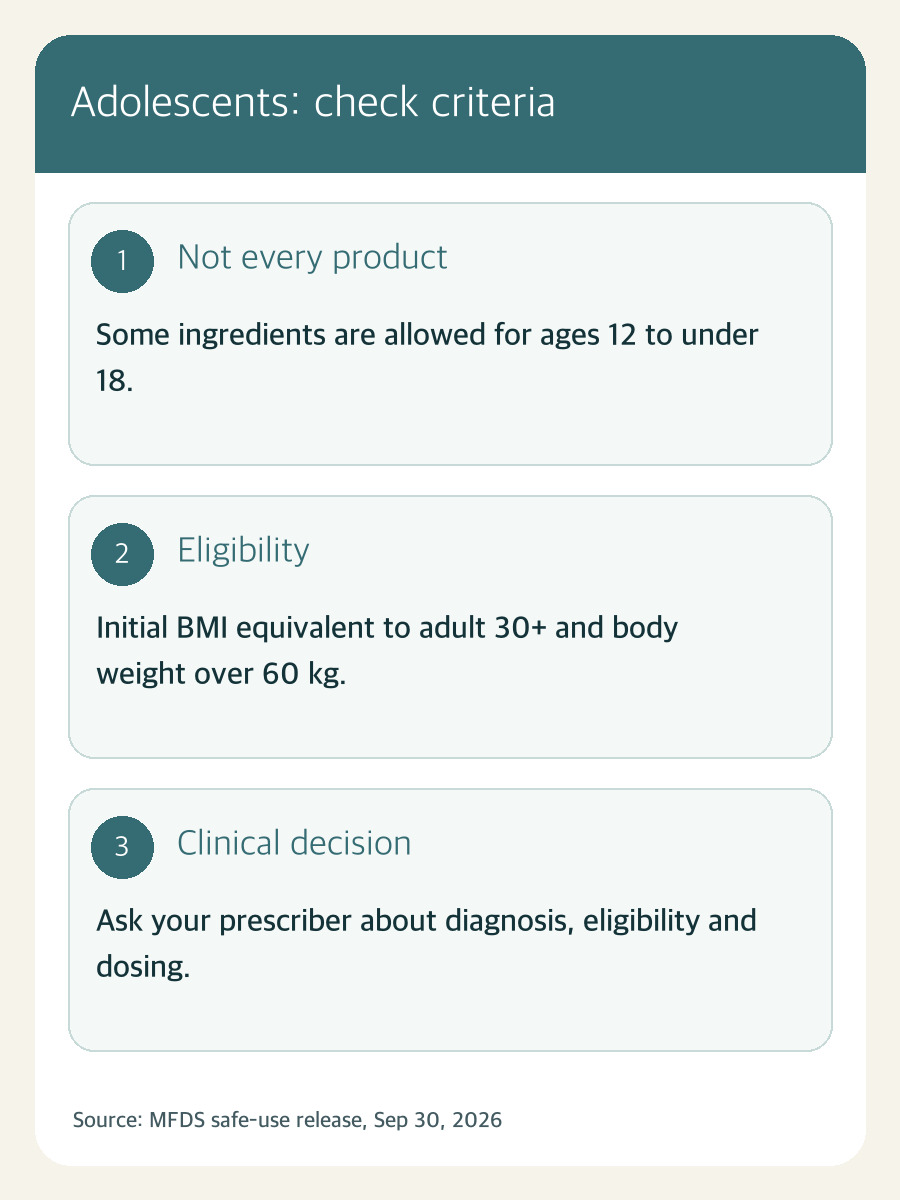
For adolescents, the scope is narrower. The MFDS says some products containing semaglutide or liraglutide may be prescribed for those aged 12 to under 18 whose initial BMI corresponds to an adult BMI of at least 30 and whose body weight exceeds 60 kg. “Exceeds” does not mean “at least 60 kg”. This is not an approval for every product or for all young people in that age range. Growth and development require additional care: a clinician should guide the starting dose, monitor nutritional intake and weight change, and watch for dehydration after nausea or vomiting. Do not buy a product from an online reseller or share another person's prescription.
Pregnancy, nursing and plans to conceive
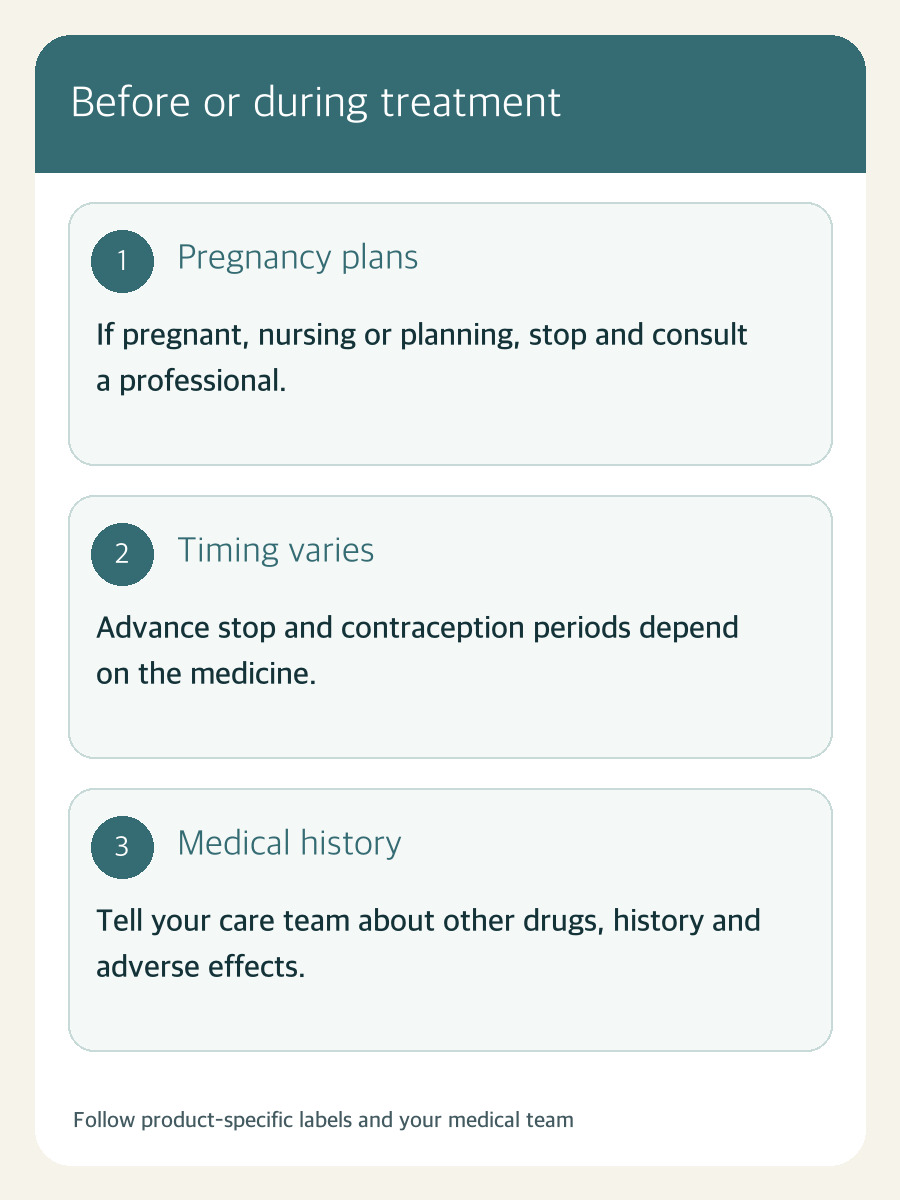
The MFDS advises someone who is pregnant, nursing or planning a pregnancy to stop administration and consult a professional immediately. Evidence for safety during pregnancy remains insufficient. For pregnancy planning, drug persistence matters: the release refers to at least approximately one to two months of contraception after stopping, depending on the medicine. It is not a universal “wait exactly two months” rule. Tell your care team which medicine you used and when, and follow the specific product label and individualized medical advice, especially if you are also being treated for another condition.
Four questions before and during treatment
- Who prescribed and dispensed it? The medicine requires a doctor's prescription and pharmacist's dispensing and counselling. The MFDS warns against overseas online purchasing and person-to-person distribution, whose safety cannot be assured.
- What else are you taking? Combining it with diabetes medicines may increase the risk of low blood glucose. Ask a clinician whether treatment needs adjusting rather than changing doses on your own.
- How is this product stored? The MFDS advises refrigerated storage away from light. Do not use a product that froze or shows particles or discoloration; ask a pharmacist how the actual product should be handled or discarded.
- What symptoms should be reported? Gastrointestinal and injection-site reactions can occur, while hypersensitivity and acute pancreatitis are among clinically important potential adverse reactions. Tell your clinician or seek care when symptoms appear, with particular attention to dehydration and nutrition in adolescents.
The cover is an AI-generated conceptual image, not an image of actual GLP-1 packaging or a real patient; the two explanatory cards are original editorial graphics. The conditions quoted above are scope-of-use criteria in a Korean announcement, not a self-diagnosis checklist. If a medicine's authorized indications or dosing differ, the actual label and treating clinician take priority.
A shorter Korean checklist is available in the Life Mokcha Naver article.
About the Author
The Life Mokcha editorial team (목차지기) separates adult, adolescent and pregnancy-planning advice so a broad drug-class headline does not become a one-size-fits-all treatment claim.
References
- MFDS, “Safe use of GLP-1 obesity medicines” (September 30, 2026; Korean)
- Official MFDS press-release PDF (adolescent criteria, pregnancy and adverse effects; checked September 30, 2026; Korean)