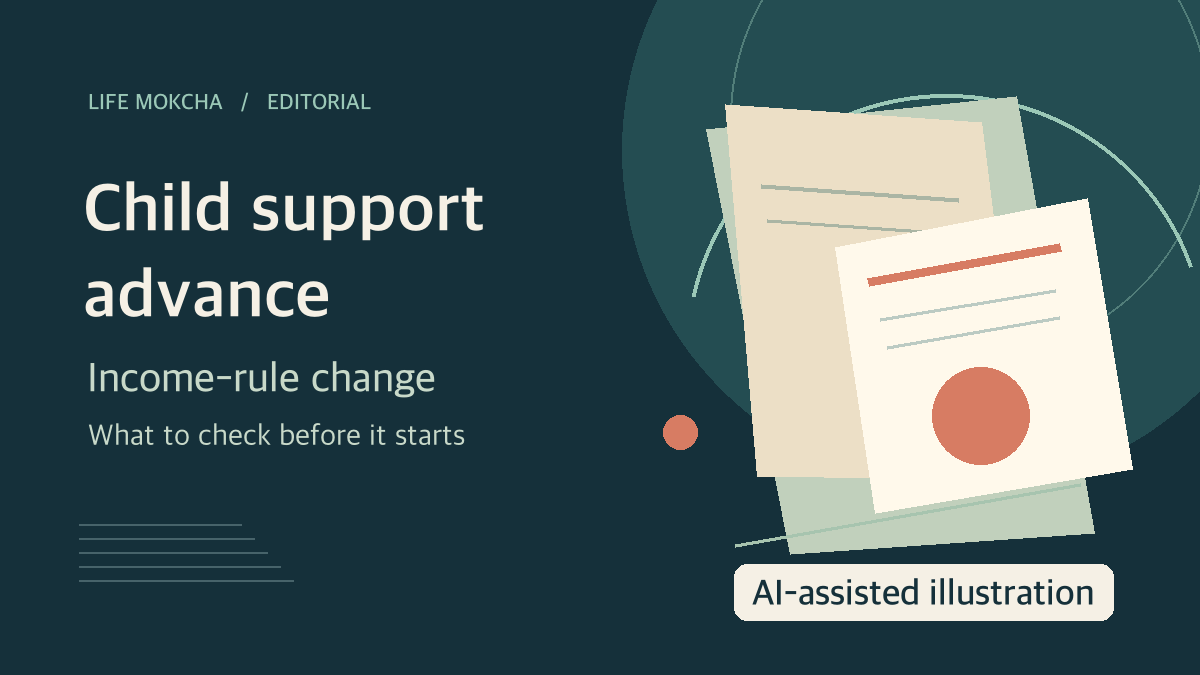
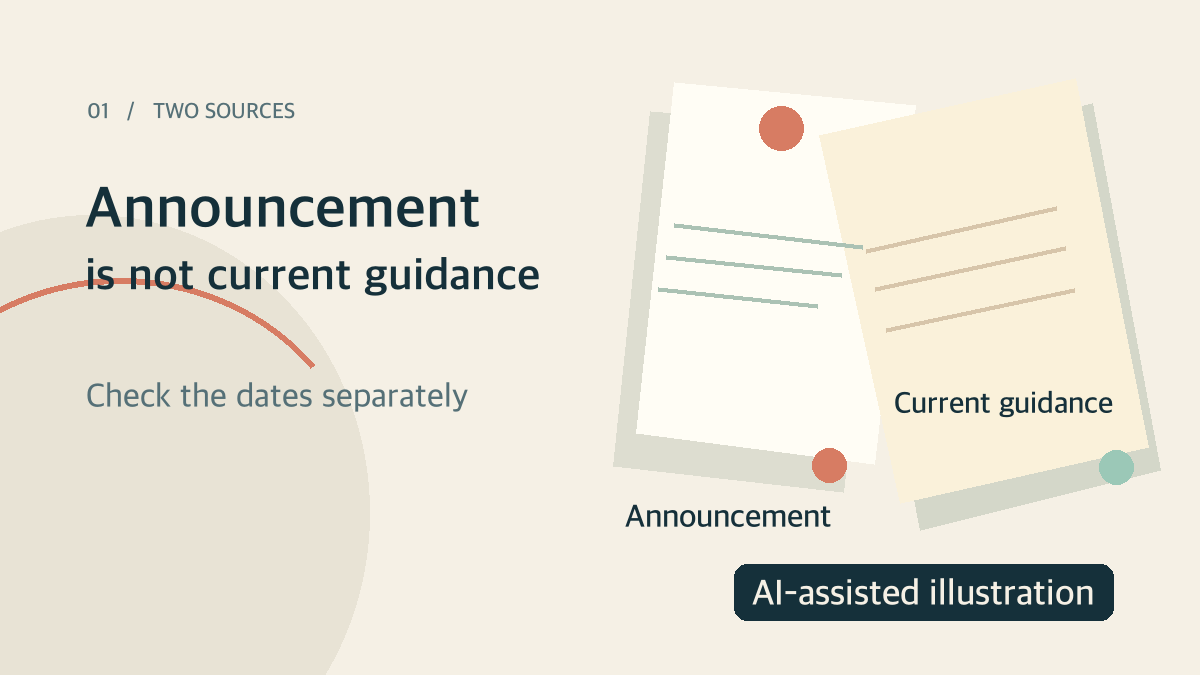
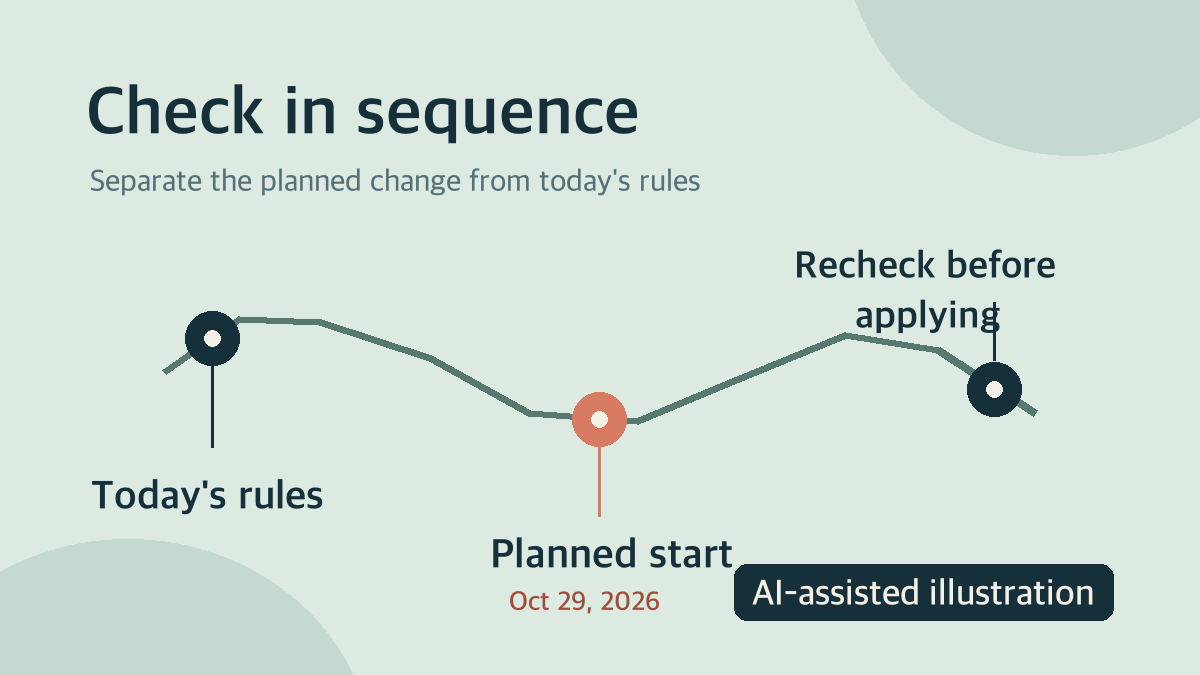
A Korean government announcement and the agency's application guide currently give readers different answers to the income question. They are describing different dates. The Ministry of Gender Equality and Family (성평등가족부)'s September 21 announcement says the income requirement for the child-support advance (양육비 선지급) will be removed from October 29, 2026. When checked October 6, 2026 (KST), the Child Support Agency (양육비이행관리원)'s existing guide still required the applicant household to be at or below 150% of median income. Do not read the future rule as an approval granted today.
What the payment is—and what the reform is not
Under this scheme, the state can advance child support to an eligible minor child whose noncustodial parent is not paying, then seek recovery from that parent. The announced reform removes the household-income threshold, not the need to establish a support entitlement or show underpayment and collection efforts. It is not a general KRW 200,000 payment to every single-parent household.
An applicant needs an enforceable document setting out recurring support, such as a court judgment or a formal child-support agreement record (양육비부담조서). The agency's present guide says the document must establish the payment schedule, amount and obligated parent. If you do not have an enforceable title, its guide points to legal assistance for securing support; this article cannot turn an informal promise into one.
Translate the two look-back descriptions carefully
The ministry says the monthly average actually received during the three months (or three payments) before the application month must be less than the prospective advance. The agency's current criteria say the three months before the application month and give an example: an application on September 13 examines June, July and August. The agency's document list asks for recent three-month account transactions from the account intended to receive support.
Those are not interchangeable promises. In particular, “three payments” in the ministry's wording should not be paraphrased as “miss three installments and you qualify.” If payments are irregular, seek clarification from the operator about the period and average it will use for your case. Nor does the income reform erase the requirement to demonstrate collection efforts: the agency names its own legal or debt-collection support, or relevant completed or ongoing support-enforcement proceedings, as examples.
Documents to locate before using the application screen
The operator's current required-document page separates the evidence into several jobs:
- Apply and consent: signed application, administrative-information sharing consent and privacy consent; check original signatures, household-member consent and any guardian consent for a child under 14. A postal application must include the application form as well as supporting papers.
- Establish the obligation: an enforceable support title and proof of service and finality, where requested.
- Show the shortfall and collection efforts: transactions over the recent three months for the support-receiving account, plus an applicable proof of an effort to secure payment. The list gives, among others, agency legal/collection-support intake confirmation, a court direct-payment or enforcement-related order, civil execution paperwork, or confirmation of a specified administrative request. Check which one applicable item you actually have rather than sending an unsupported assertion.
- Identify the payee and family: applicant-name bank account copy; detailed basic/family-registration certificates for the applicant and child, and the applicant's marriage-registration certificate. Some certificates must be issued within three months; documents for each child may be required.
This is a description of the page visible on October 6, not a claim that the forms or screening fields will be identical on October 29. Do not assume the current online self-check has already been revised to ignore income.
Where to apply, and why October 25 is not the start date
The agency guide points to 선지급 → 지원신청 for online applications. It also describes mailing the form and documents to (04554) 서울특별시 중구 퇴계로 173, 24층 양육비이행관리원 선지급 담당자 앞. Check the address and updated application instructions before mailing personal documents. Submission is followed by document review and an eligibility decision.
The stated benefit is up to KRW 200,000 per eligible child per month; the agency's public application guide also says it cannot exceed the amount established in the enforceable title. The ministry says payments ordinarily arrive around the 25th of a month, but adds a narrower commencement rule: removal of the income requirement applies to the October advance-payment installment decided after the law takes effect on October 29. It does not promise a new-rule deposit on October 25 or an automatic October award for every new applicant. The agency's September 28 notice text also gives October 29 as the income-removal date.
For a shorter Korean pre-application check, see the Life Mokcha Naver edition.
About the Author
Life Mokcha's editorial team distinguishes the announced commencement from the operator's presently published eligibility and document guidance. An actual award and amount depend on an individual agency decision, not this explainer.
References
- Ministry of Gender Equality and Family / Korean government policy portal, September 21, 2026 announcement (Korean)
- Child Support Agency, current advance-payment guide (Korean; still shows 150% test at check time)
- Child Support Agency, required-documents page (Korean)
- Child Support Agency, public application-guide page (Korean; current income criterion and award ceiling)
- Child Support Agency, September 28, 2026 notice text on removal date (Korean)