On September 24, 2026, Korean wildlife-video creator Dahuk (다흑) posted a video titled in Korean roughly “What's happening in Busan?! Giant ‘money bugs’ have appeared”. The video's description claims that rumors of an Okinawan giant house centipede living in Korea have proved true. That is the creator's claim, not an independent identification or distribution study. We have not independently established the exact filming location, specimen provenance, specialist identification, or evidence of an established breeding population.
Four claims require four different kinds of evidence
| Claim | Evidence checked | What it does not establish |
|---|---|---|
| A creator posted a Busan-themed video about a giant “money bug” | Original Dahuk video, title, description and publication metadata | Independent verification of the precise site or collection history |
| A species associated online with an Okinawan giant house centipede exists | GBIF taxon record for Thereuopoda clunifera | That the filmed specimen belongs to this species |
| The animal in the video is that species | No independently verifiable expert determination obtained for this article | Appearance, apparent size and a place-name alone are not a diagnosis |
| The species is established or spreading in Busan | No separately verified reproduction or repeated population records obtained | One reported sighting does not prove establishment or a route of introduction |
Real-animal photo notice: The next two pictures show other reference animals. If such photos are uncomfortable, you can skip past them and read the descriptions.
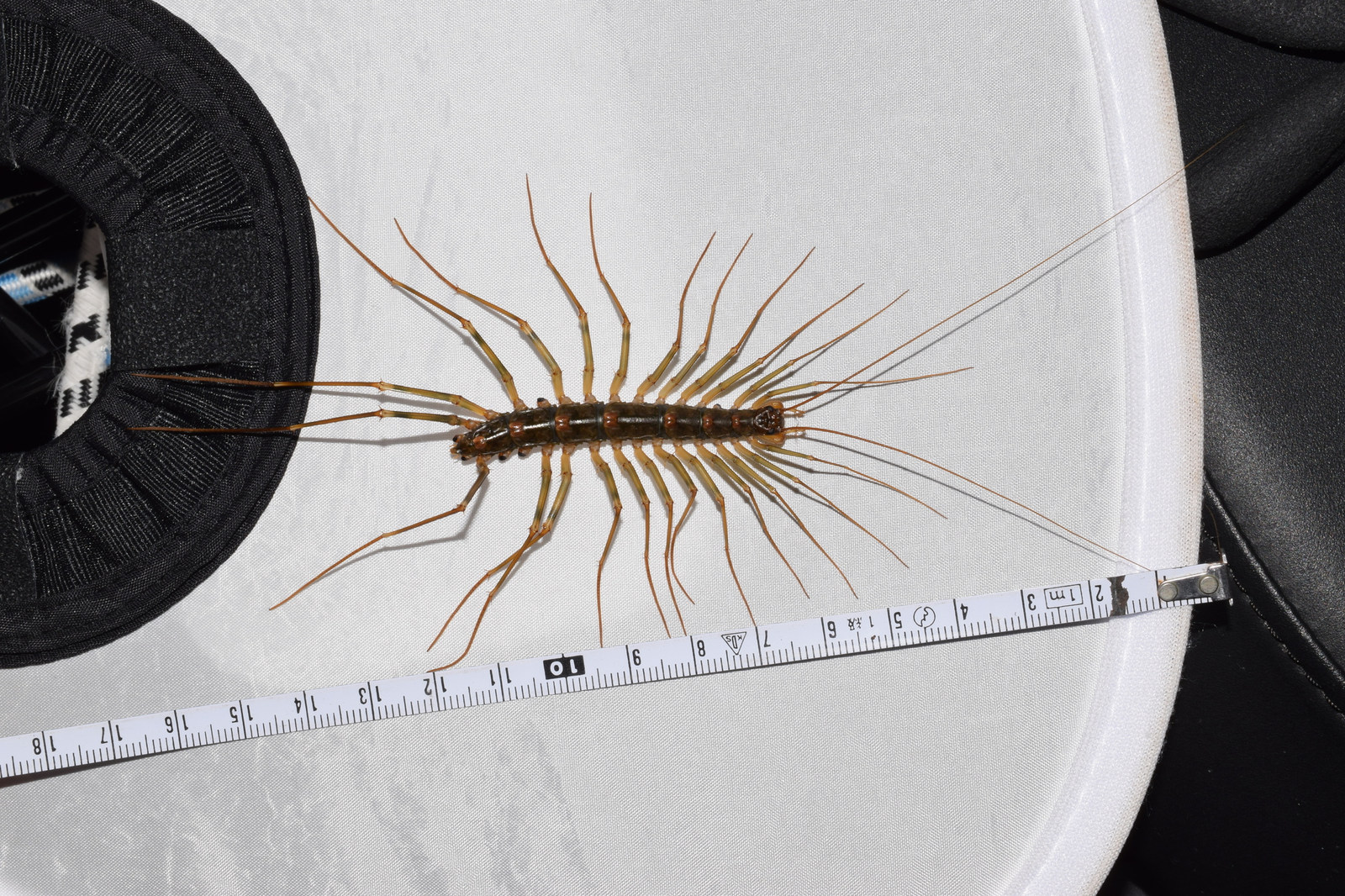
What this second photo adds: It shows the whole trunk, long legs on both sides, antennae and a measuring tape in one frame. It helps readers see why a useful observation should include the appendages as well as the body. It documents another reference animal, not the filmed individual's size or identity. Photo: heikindai_87, CC0.
In Korean, donbeolle (“money bug”) is a colloquial name used for long-legged house centipedes, not a precise scientific species name. Centipedes are arthropods in class Chilopoda, not insects. T. clunifera is a recognized species in an international biodiversity register, but the existence of its taxon entry cannot authenticate a particular animal in a video. Neither can the words “Busan” and “Okinawa” in a discussion establish that this specimen travelled from one to the other.
Why a database search is not a verdict of absence
A GBIF occurrence search filtered to South Korea did not return a public record for this species when checked on September 26, 2026. That is a statement about a search of publicly indexed records at one point in time, not proof that the species has never been in Korea. An observation may be unreported, misidentified or not yet indexed. Equally, a video by itself cannot demonstrate an established population. Provenance, date and location, diagnostic features, expert review and repeat observations would make a stronger case.
The creator's description says the rumor is “proven”; this article attributes that assertion to the creator. It does not cite it as an official finding by a Korean biological authority. We have not verified claims that this is the country's “first record”, an “invasive outbreak” or a breeding population.
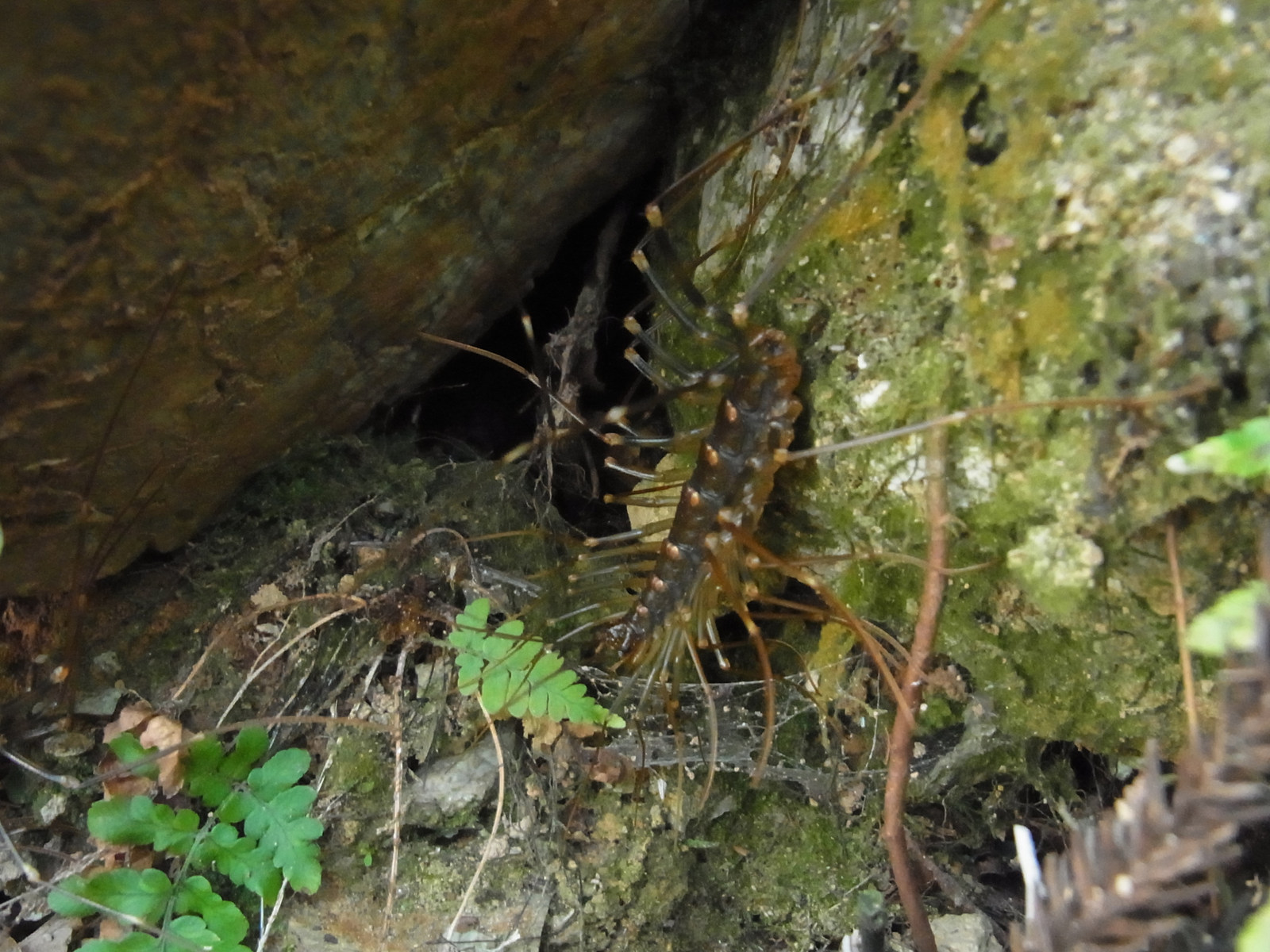
The third photo shows a separate reference animal among rocks and moss outdoors in Kochi Prefecture, Japan. Its surroundings are not presented as the Busan filming site or evidence that the species has established a population in Korea. Photo: heikindai_87, CC0.
Are house centipedes pests? What should you do at home?
The University of California Integrated Pest Management program describes centipedes as predators. House centipedes may capture flies, cockroaches and other small household pests. Large centipedes of some kinds can nevertheless bite when provoked, causing localized pain or swelling. These are general centipede facts, not a species-level risk assessment of the animal in the video. “It eats cockroaches” does not mean it is safe to pick up with bare hands; “it looks large” does not mean it will attack people.
- Keep children and pets away and do not handle or disturb an unidentified centipede to obtain a photo.
- From a safe distance, note the date, approximate location and visible full-body features. Avoid publishing an exact private address or someone else's footage.
- If it appears repeatedly indoors, check moisture, gaps and potential prey insects; ask a reputable local biological specialist for identification where needed.
- Seek medical care for severe pain after a bite. For acute allergic symptoms such as trouble breathing or throat swelling, call Korea's emergency number 119 immediately. This is general emergency guidance, not a toxicity assessment of the reported animal. Do not improvise a species-specific treatment based on a viral video.
Bottom line: A notable video was posted, but identification, establishment and the purported Okinawa-to-Busan route remain separate questions. If documented expert identification becomes available, the open points can be updated. Our short Korean explainer on Naver focuses on the immediate viewer questions. Both lead images are AI-generated illustrations; the two subsequent real photos show other reference animals, not the animal filmed in Busan.
About the Author
Life Mokcha's editorial team (‘Mokchajigi’) separates a reported wildlife sighting from independently checkable species, distribution and home-safety evidence.
References
- Dahuk, original giant-centipede video (Korean) (posted September 24, 2026; the description contains the creator's claim)
- GBIF Backbone Taxonomy, Thereuopoda clunifera (taxon registration, not an identification of the video animal)
- GBIF public occurrences filtered to South Korea (search records can change)
- University of California IPM, Centipedes and Millipedes (updated June 2023; general ecology and management)